Roland FP-30X Review: The Mid-Range King That Earns Its Crown
Everyone recommends the FP-30X. YouTube, Reddit, every music store salesperson. I spent four weeks with it on my desk to find out if the universal praise is justified—or if it is just clever marketing on autopilot.

Julian Harmon
Concert Pianist & Reviewer · April 20, 2026 · 10 min read
PianoXpert Rating
9.0/10
The Roland FP-30X: Roland's sweet spot between budget and premium.
If you have been researching digital pianos for more than 15 minutes, you have seen the Roland FP-30X recommended. It shows up on every Reddit thread, every YouTube roundup, every “best piano under $800” list.
And after four weeks of rigorous testing, I understand exactly why. The FP-30X occupies a rare sweet spot where the key action, sound engine, and connectivity all perform at a level that simply should not exist at this price point.
But it is not perfect. Let me tell you exactly where it excels, where it stumbles, and who should buy it.
The PHA-4 Standard Action: Still the Benchmark
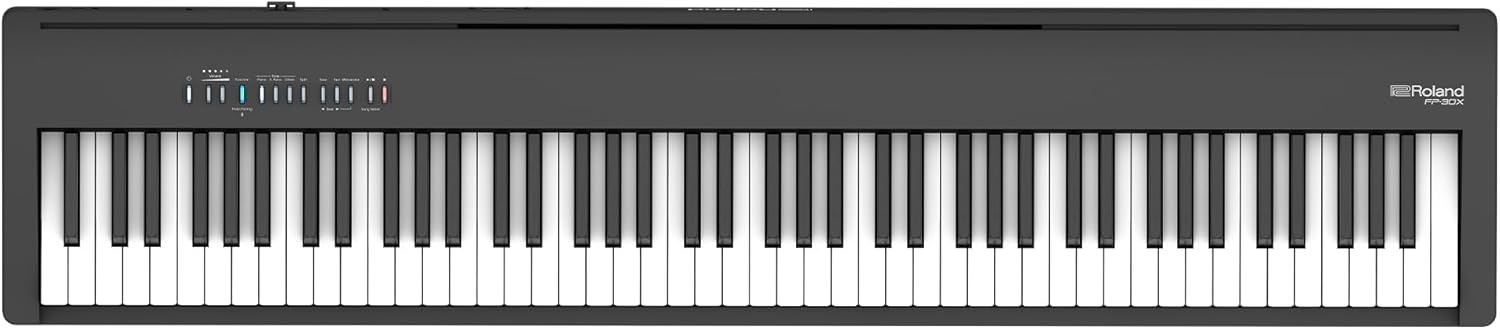
The FP-30X uses Roland's PHA-4 Standard keyboard—the same mechanism found in their FP-10 and several higher-priced models. It is an 88-key, fully weighted, graded hammer action with escapement and ivory-feel textured keys.
If you have read my Roland FP-10 review, you already know I consider this one of the finest key actions in the sub-$1000 category. The grading is natural—bass keys require noticeably more force than treble keys, exactly like an acoustic grand.
The escapement mechanism is the real differentiator. When you press a key slowly, you feel a subtle “notch” near the bottom of the stroke. This replicates the let-off point of an acoustic piano hammer mechanism. It matters tremendously for pianissimo control and developing proper technique.
During my testing, I ran through Chopin's Nocturne Op. 9 No. 2 repeatedly. The action responded beautifully to dynamic shading—the transition from piano to forte felt organic rather than stepped. If you are serious about building technique, read my guide on weighted vs unweighted keys to understand why this matters so much.
SuperNATURAL Sound Engine: 256 Notes of Depth
Roland's SuperNATURAL Piano engine does not simply play back recorded samples. It models the physical behavior of piano strings, hammers, and soundboard resonance in real time.
The result is a tone that breathes. When you hold down a sustained chord and add notes above it, the sympathetic string resonance evolves naturally. The decay trails off organically rather than cutting abruptly—a flaw I notice in many competing models.
With 256-note polyphony, the FP-30X handles the most demanding passages without dropping notes. For context, the Yamaha P-145 offers only 64 notes. If you use heavy sustain pedaling on Romantic-era repertoire, the difference is absolutely audible. Notes simply do not vanish mid-phrase.
You also get 56 onboard sounds beyond piano—electric pianos, organs, strings, and more. Honestly, I spend 95% of my time on the first two grand piano presets. But the Rhodes and Wurlitzer sounds are genuinely usable for session work.
The Speakers: A Genuine Upgrade
If you read user forums about the FP-10, the speaker complaints are relentless. “Thin.” “Anemic.” “Muffled.”
Roland clearly listened. The FP-30X doubles the speaker power to 22 watts (2 x 11W), and the improvement is dramatic. The bass register now carries genuine weight. The overall volume fills a living room without compression or distortion.
Are they audiophile-grade? No. This is still a portable digital piano, not a studio monitor. But for home practice and casual playing for family, the speakers are more than sufficient. This was one of the most common pain points mentioned on Reddit and Quora, and the FP-30X addresses it convincingly.
Pro Tip: Unlock the Full Potential
The speakers are good, but the SuperNATURAL engine is capable of much more. Plug in a quality pair of studio headphones—the spatial imaging and overtone detail that emerges is genuinely stunning. The piano transforms from “good digital piano” to “convincing concert grand.”
Connectivity: Where the FP-30X Pulls Away
This is where the FP-30X leaves the FP-10 and most competitors behind. The connectivity package is comprehensive:
- Bluetooth MIDI + Audio: Connect wirelessly to learning apps AND stream music through the piano's speakers simultaneously.
- USB Type-B: Direct connection to your DAW for recording. The FP-30X functions as a class-compliant audio/MIDI interface—no drivers needed.
- USB Type-A: Plug in a flash drive to play back WAV, MP3, or SMF files directly.
- Dual headphone jacks: One 1/4-inch, one 1/8-inch. Perfect for teacher-student practice sessions.
- Stereo line outputs (L/R): Dedicated 1/4-inch jacks for connecting to PA systems, mixers, or studio monitors.
That last point is critical. As I noted in my FP-10 review, the lack of line outputs was the FP-10's dealbreaker for gigging musicians. The FP-30X solves that problem entirely.
If you are wondering whether a digital piano can replace an acoustic for home use, the FP-30X's connectivity versatility makes a very strong case.
Bluetooth Audio: The Feature Nobody Talks About Enough
Many reviewers gloss over Bluetooth Audio. They should not.
With Bluetooth Audio, you can stream a backing track, a metronome app, or a YouTube tutorial from your phone directly through the FP-30X's speakers. You practice with the audio mixed perfectly with your live playing.
The FP-10 only has Bluetooth MIDI—meaning it connects to apps but cannot stream audio. The Yamaha P-145 offers Bluetooth Audio but lacks Bluetooth MIDI. The FP-30X gives you both.
The Elephant in the Room: No Display Screen
The most consistent criticism from Reddit, Quora, and YouTube comments is the lack of any LCD or LED display. Changing sounds, adjusting settings, or accessing the metronome requires memorizing button combinations or reaching for the Roland Piano App on your phone.
I understand the frustration. In 2026, even budget appliances have screens.
But here is my honest take as a performer: I prefer it this way. A clean, distraction-free control panel keeps your focus on playing. The Roland Piano App is well-designed and gives you full control with a proper visual interface when you need it. And once you set your preferred sound and leave it, how often are you really changing voices mid-practice?
FP-30X vs FP-10: Is the Upgrade Worth It?
I have tested both extensively. Here is the honest comparison:
| Feature | FP-10 | FP-30X |
|---|---|---|
| Key Action | PHA-4 Standard | PHA-4 Standard |
| Sound Engine | SuperNATURAL | SuperNATURAL |
| Polyphony | 96 notes | 256 notes |
| Sounds | 15 | 56 |
| Speakers | 12W (2×6W) | 22W (2×11W) |
| Bluetooth | MIDI only | MIDI + Audio |
| Line Outputs | None | Stereo 1/4" L/R |
| USB-A | No | Yes (playback) |
| Weight | 27 lbs | 32.6 lbs |
The core playing experience—key action and sound engine—is identical. But the FP-30X adds everything the FP-10 lacks: more polyphony, better speakers, Bluetooth Audio, line outputs, and USB storage playback.
If your budget allows it, the FP-30X is the smarter long-term investment. If budget is extremely tight, the FP-10 still delivers the same outstanding key action.
Who Should Buy the Roland FP-30X?
Buy it if: You are a beginner who wants an instrument you will not outgrow for 5+ years. You are an intermediate player who needs a reliable practice piano. You are a gigging musician who needs portability with professional outputs. You want to use your piano as a MIDI controller with a DAW.
Skip it if: You need a screen-based interface and refuse to use a phone app. You are on an extremely tight budget under $500—look at the FP-10 instead. You need a workstation-style arranger keyboard with hundreds of rhythms and auto-accompaniment.
Final Recommendation
After four weeks of daily playing, the Roland FP-30X has earned its reputation. It is not the cheapest option. It is not the most feature-packed. But it strikes a balance between authentic piano feel, musical sound quality, and practical connectivity that no other instrument in this price range matches.
Roland made a smart decision: invest heavily in the key action and sound engine—the two things that matter most to a pianist—and give everything else “good enough” treatment. The result is an instrument that feels and sounds far more expensive than it is.
If you are spending $600–$800 on a digital piano, the FP-30X should be at the very top of your shortlist. It is the instrument I recommend most often to my students, and after this review, that is not changing.
Not sure which piano is right for you? Try our Piano Finder tool or browse my picks for the best digital pianos for beginners.
What I Loved
- • PHA-4 action with escapement—class-leading
- • 256-note polyphony handles complex repertoire
- • Bluetooth MIDI + Audio is incredibly useful
- • Dedicated stereo line outs for live use
- • 22W speakers are a massive upgrade over FP-10
What Frustrated Me
- • No display screen—reliant on app for settings
- • Included sustain pedal is cheap plastic
- • Heavier than the FP-10 at 32.6 lbs
- • No stand or bench included at this price
Frequently Asked Questions
Is the Roland FP-30X good for beginners?
The Roland FP-30X is one of the best digital pianos for beginners who are serious about learning. The PHA-4 Standard action with escapement develops proper finger technique from day one, and you will not outgrow this instrument for years. It is a buy-it-right, buy-it-once investment.
What is the difference between the Roland FP-30X and FP-10?
Both share the same PHA-4 Standard key action and SuperNATURAL sound engine. The FP-30X adds 256-note polyphony (vs 96), Bluetooth Audio (not just MIDI), dedicated 1/4-inch stereo line outputs for gigging, USB-A for WAV/MP3 playback, 56 sounds (vs 15), and significantly more powerful 22W speakers (vs 12W). If you need to perform live or want more versatility, the FP-30X is the clear upgrade.
Can the Roland FP-30X be used for live performances?
Yes. Unlike the FP-10, the FP-30X includes dedicated 1/4-inch stereo line outputs (L/R), making it reliable for connecting to PA systems, mixers, and audio interfaces. It is a legitimate gigging instrument for working musicians who need portability.
Does the Roland FP-30X have Bluetooth?
Yes, the FP-30X features both Bluetooth MIDI and Bluetooth Audio. Bluetooth MIDI lets you connect wirelessly to learning apps like Roland Piano App or GarageBand. Bluetooth Audio lets you stream music from your phone through the piano's speakers, so you can play along with your favorite songs.
Is the Roland FP-30X better than the Yamaha P-145?
The FP-30X outperforms the Yamaha P-145 in nearly every specification: 256-note vs 64-note polyphony, 56 vs 10 sounds, Bluetooth MIDI and Audio vs Audio only, dual line outputs, and more powerful 22W speakers. The P-145 is lighter and cheaper, but the FP-30X offers significantly more value for serious players.
Are the speakers on the Roland FP-30X good enough for home practice?
The FP-30X features a 22W stereo speaker system (2 x 11W), which is a major upgrade over the FP-10. They are more than adequate for home practice and small room performances. For large rooms or critical listening, I still recommend quality headphones or external studio monitors to hear the full depth of the SuperNATURAL engine.
Still Undecided?
Not sure if the FP-30X is exactly right for your situation? Take our 60-second quiz to get a personalized recommendation.
🔍 Launch the Piano FinderJulian Harmon
Concert Pianist & Lead Reviewer
Julian has spent over 30 years performing on both digital and acoustic pianos worldwide. He founded PianoXpert to provide honest, musician-first advice. Read more about Julian →